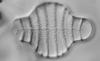
Original Description: Valves linear at centre, shallower at the poles, tapering further towards the apices, length 20-25µm, breadth 10-15µm. Transapical ribs robust, mostly primary, few secondary and tertiary; 4-6 in 10µm. Striae parallel to each other and to the ribs, appear as simple holes through the basal siliceous layer; 10-20 in 10µm, 5-8 between (primary) ribs. Sternum central, linear, slightly raised; pore fields appear absent, although polar striae somewhat more compact than those composing valve surface.
Tetracyclus: Tetracyclus arceli
Type Status: Holotype
Institution Code: BM
Collection Code: BM
Catalogue Number Text: 101138
Basis of Record: Fossil Specimen
Taxonomic Name: Tetracyclus arceli
Identified By: David M Williams
Date Identified: 2006
Locality: Academician Ridge of Lake Baikal (53°44′48″ N and 108°24′34″ E); water depth 333m (core sample 5043).
Valves linear at centre, shallower at the poles, tapering further towards the apices, length 20-25µm, breadth 10-15µm. Transapical ribs robust, mostly primary, few secondary and tertiary; 4-6 in 10µm. Striae parallel to each other and to the ribs, appear as simple holes through the basal siliceous layer; 10-20 in 10µm, 5-8 between (primary) ribs. Sternum central, linear, slightly raised; pore fields appear absent, although polar striae somewhat more compact than those composing valve surface.
Rimoportulae present, large slit (1—1.5µm), usually situated at a pole, often partly on mantle.
Cingulum partly known. Valvocopula, open band, attaching by crenulated lip overlaying ribs of valve; pars interior consisting of 2-6 distinct rows of poroids (which coalesce internally); ligula absent; septum extending from pars interior with small pore penetrating pole of band. Other bands not observed.
T. arceli is distinguished by its shape; in larger specimens the outline of the valve is more regular and less undulated than that of T. emarginatus (Ehrenb.) W. Smith (Williams 1987).
Tetracyclus: Tetracyclus arceli
The diatom genus Tetracyclus Ralfs is largely composed of extinct, freshwater species many of which have been used as stratigraphic markers for several continents under the assumption that they are relatively widespread and confined to precise geological epochs.